



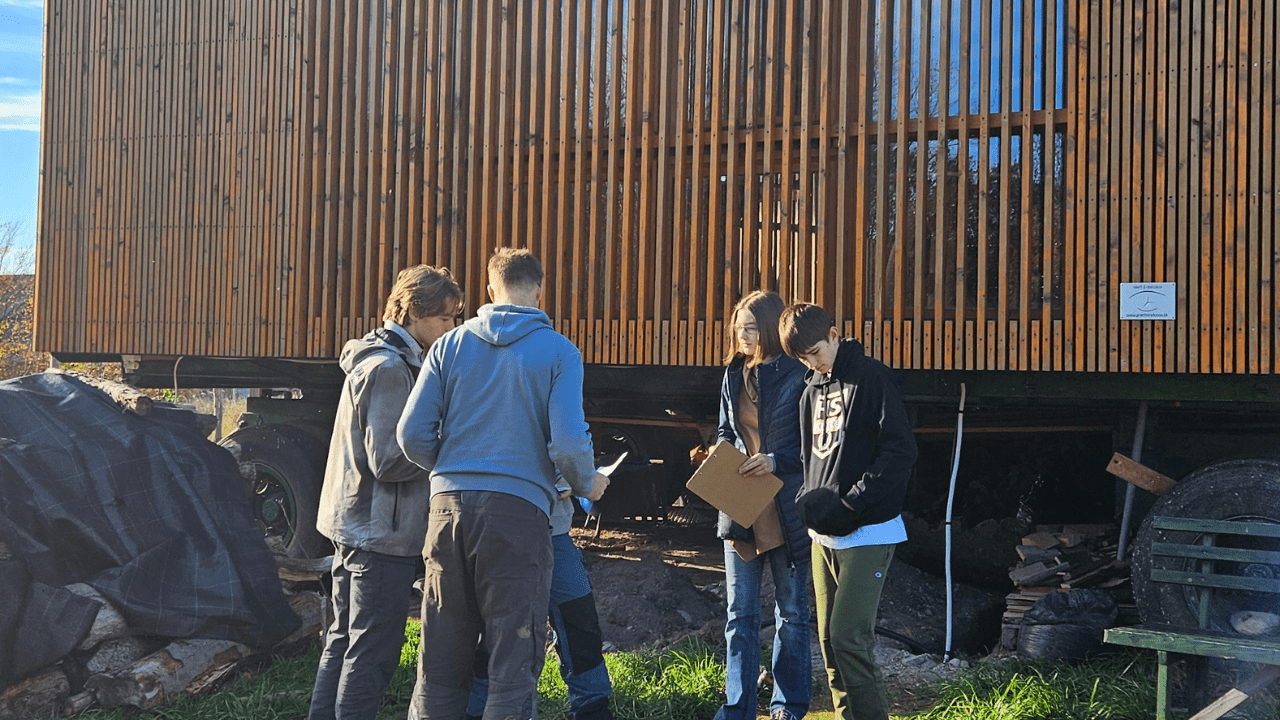
Water is life – climate adaptation of the Jolly school farm
Not every good idea is born at a desk or in a classroom. Sometimes it emerges directly in the field—from observing nature, working with the soil, and from a simple yet essential need: to have water on the farm in all weather conditions. That is exactly how our project Water is Life – Climate Adaptation of the Jolly School Farm came to life.
The idea of introducing drip irrigation on the farm had already been there last year. However, it was then that we fully realized that a good idea needs time, planning, and people who can shape it into a clear vision. This only became possible this year, when Vierka presented the final concept of the project. It was so well thought out and strong that it also caught the attention of the E.SK Foundation, which supported our project with a €10,000 grant. At that moment, the vision began to turn into reality.

From the very beginning, we knew that enthusiasm alone would not be enough for such a project—we also needed expertise. Therefore, we reached out to experts in photovoltaics, water management and collection, as well as architects and builders, who helped us prepare everything necessary. The project thus became a beautiful example of collaboration between the school and the wider community.
Our students also play a significant role in it. The first project sketch was created by a 9th-grade student, Matúš Nagy, who is also involved in preparing the final design. For us, this is proof that when young people are given trust and space, they are capable of coming up with solutions that have real value.
Project Implementation
However, the path to implementation was not always easy. We went through an interesting—and very educational—experience with the building authority, where we learned that decisions regarding structures require thorough documentation and, above all, patience. Thanks to this, we adjusted our original plan: instead of rainwater collection tanks, it is more beneficial for us to build an additional underground reservoir.
Just before Christmas, however, we experienced a wonderful moment—as an early gift, the construction of a shelter for solar panels was approved, along with its placement. Shortly after, on November 24, an excavator dug seven two-meter-long garden beds, visibly moving the project forward.
We Stay Active During Winter
Winter is a time of preparation for us. We actively promote the project, share its vision, and wait for the soil to soften. In March, we plan to begin digging trenches for water pipes, and in April, we aim to complete the shelter. Each step brings us closer to our goal—a sustainable, resilient, and modern school farm.
This project is not only about technology and water. It is about education, collaboration, responsibility toward nature, and the courage to seek solutions in times of climate change. Our ambition is to share our experience with the public and show that even a school project can have a real impact and inspire others.

Because water is life. And learning how to manage it wisely is one of the most important lessons
we can give to young people today.
Final Report
Water is Life – Climate Adaptation of the Jolly School Farm
The project “Water is Life – Climate Adaptation of the Jolly School Farm” responds to climate change, especially the lack of water during dry months. Its aim is to increase rainwater harvesting capacity by installing 7 new containers and to introduce drip irrigation, ensuring sustainable care for permaculture beds. The project connects pupils’ environmental education with real work in nature
and actively involves parents, the community and experts. The result will be a more ecological, more functional farm and a practical outdoor classroom about water, responsibility and climate.
Approved budget
€10,000
Project category
Local climate transformation
Public benefit purpose
Development of science and education
Basic Information
Applicant
Organisation name:
Súkromná základná škola Jolly HOMESCHOOL
Registered address:
Kukučínova 4, 902 01 Pezinok
District:
Pezinok
Company ID:
55319572
Legal form:
contributory organisation
Date of registration:
8 March 2023
File number:
Ministry of Education, Research, Development and Youth of the Slovak Republic, reg. no. 100018902
Registrar:
Ministry of Education, Research, Development and Youth
Website and/or social media:
www.jollyhomeschool.sk
Contact person
Name and surname:
Viera Machálková
Phone:
0902 325 787
Email:
vmachalkova@gmail.com
Statutory representative
Name and surname:
Mgr. Eva Skovajsová
Position:
school principal
Phone:
0902 325 787
Email:
skola@jollyhomeschool.sk
For personal data protection reasons, internal identification details such as bank account number, birth identification number, ID card number and private address are not published on this public website.
Project Information
Project title:
Water is Life – Climate Adaptation of the Jolly School Farm
Project category:
Local climate transformation
Public benefit purpose of the project:
development of science and education
Project location:
Jolly Farm, Pezinok – part of the school garden of SZŠ Jolly HOMESCHOOL.
Brief Description of the Applicant
Súkromná základná škola Jolly HOMESCHOOL in Pezinok is an innovative educational institution that connects environmental education, practical skills and community cooperation. Within the school, a unique concept of a school farm has been created, serving as a living open-air classroom. Pupils, teachers, parents and experts work together to develop a sustainable space with an emphasis on environmental responsibility and conscious management of natural resources.
Basic Project Objectives
The “Water is Life” project reflects the growing problem of drought and climate change. Our aim is to:
Increase rainwater harvesting capacity with 7 new ecological containers.
Connect the garden beds to drip irrigation in order to minimise water waste and increase irrigation efficiency.
Develop pupils’ environmental literacy through practical education about water resources and climate adaptation.
Inspire communities and schools in the region and beyond through sharing experience and workshops.
Initial Situation / What the Project Aims to Address
In 2021, we established the school farm as a response to the need for environmental education in practice. However, we are facing the real consequences of climate change – during the dry months (June – September), our existing water storage capacity (3 × 1,000 l + a 6,000 l underground tank) is not sufficient.
In May 2025, due to water shortage, we even had to drill a well to a depth of 86 metres.
The project responds to this situation by expanding water harvesting capacity and introducing efficient drip irrigation.
Here is a video of pupils from the school farm and their reflections:
Target Groups
(Grades 1–9)
Number of direct participants involved in the project: 5
Organisations and Communities Involved in Project Implementation
Implementation Team
Project organiser:
Mgr. Viera Machálková
Pedagogical collaborators:
Michael Frontczak, Mária Mezeiová
Technical solution:
Vlado Wagner – Priestor s dušou, production and installation of water collection containers and irrigation
Expert support:
Ľubomír Varga, parent and consultant
Parent Community of SZŠ Jolly HOMESCHOOL
Parents are actively involved in building and maintaining the farm – they help during volunteer workdays,
donate materials, provide transport and consultations, for example in the area of well drilling
or rainwater harvesting. An example is Mr Ľubomír Varga, who participates in the technical solution
and has long cooperated with the school as a volunteer.
Local Company Priestor s dušou – Vladimír Wagner
A long-term partner of the school in the field of sustainable solutions – designs and produces ecological
buildings and structures, including water collection containers, dry toilets and shelters.
Town of Pezinok
Provides support for community activities and communication with local government – in the past,
it supported the school’s community events and enabled the use of local public spaces,
such as the market square for selling produce.
Community Garden Pezinok
A partner for exchanging experience and seeds; we organise joint workshops and exchanges of plants
and know-how in ecological growing.
Malokarpatská Library in Pezinok
Cooperation on environmental lectures and reading projects focused on nature, climate and ecological
topics for children.
Volunteers from the Local Community and Farm Neighbours
They help with harvesting, organising the fair and taking care of the garden beds during the summer holidays.
Communication Plan
Project Sustainability
The water collection containers and irrigation system will become a permanent part of the farm with minimal maintenance requirements. Operation and maintenance will be ensured by a team of teachers and parents who are already actively involved in the farm’s activities.
The project will be part of the school educational programme, including subjects such as Biology,
Environmental Education and Project-Based Learning. In cooperation with the community and partners, we will secure long-term funding through the sale of products, crowdfunding and other grants.
Environmental Measures within the Project
Rainwater collection and reuse
Efficient use of natural resources.
Drip irrigation
Minimising water consumption and evaporation.
Permaculture beds
Supporting biodiversity and healthy soil without chemicals.
Solar lighting and composting
Sustainable operation of the farm.
Education about climate change
Pupils understand the consequences of climate change in practice.
Project Activities
The project activities will begin with a preparatory phase – we will secure the purchase and production of water collection containers,
a solar pump and the irrigation system, and arrange expert cooperation.
Installation of 7 new rainwater containers, their connection, installation of drip irrigation and solar power.
We will also install wooden roofs above the containers to protect the water from overheating.
The system will be put into operation, and pupils will actively participate in measuring water consumption
and educational activities about the importance of water.
Autumn planting will take place, and a natural pond will be established as a watering place for pollinators.
We will complete the educational trail with information boards and organise a community workshop on rainwater harvesting.
Pupils will process the outputs into posters and stories, and the methodological guide will be created.
We will focus on system maintenance, planning the new season and educational workshops for teachers,
including the publication of the guide.
We will begin spring planting and complete the educational trail.
April will be dedicated to a community day with interactive stations and a public presentation of the project.
We will evaluate the project, harvest the produce and make it available to the community again through sales and a final presentation.
How the Project Contributes to Environmental Improvement
Our school farm is a place where children learn not only to understand nature, but also to protect it. This project responds to the challenges we are already experiencing today – increasingly long periods of drought, depleted soil and diminishing water resources.
Through this project, we are giving practical meaning to the idea of thinking about the future.
Rainwater harvesting and drip irrigation are not merely technical solutions.
They represent respect for one of our most precious resources – water, the source of life.
When children connect irrigation hoses with their own hands and observe how water slowly reaches the roots of plants, they learn much more than gardening skills. They learn patience, responsibility and respect for nature.
The project contributes to environmental protection in several ways:
During dry months, rainwater provides an alternative water source for irrigation, helping to preserve valuable drinking water.
Drip irrigation delivers exactly the amount of water plants need, reducing nutrient loss and soil erosion.
The farm creates a safe habitat for bees, butterflies and other beneficial wildlife whose populations are declining.
Children who understand natural processes are better prepared to seek solutions rather than excuses.
Every activity we carry out—from preparing the soil to planning irrigation—is also a conversation with nature.
We learn to listen, observe and act responsibly. We believe this project will contribute not only to a greener school farm,
but also to a more conscious, resilient and compassionate community.
Budget
| Budget Item | Amount |
|---|---|
| 1. Rainwater collection containers (1,000 l, filter, outlet, UV protection) | €1,260 |
| 2. Connection of containers, valve system, hoses and filters | €300 |
| 3. Drip irrigation system for 10 garden beds | €500 |
| 4. Professional installation of rainwater containers and irrigation | €500 |
| 5. Mini pump and solar-powered water distribution system | €1,500 |
| 6. Wooden roof structures above the containers | €840 |
| 7. Construction of a small natural pond for pollinators | €1,000 |
| 8. Educational trail about water and climate adaptation | €900 |
| 9. Educational workshop “Water is Life” | €800 |
| 10. Graphic design and professional preparation of the methodological guide for schools: “How to Teach About Water Through Practice” | €700 |
| 11. Reserve fund and long-term maintenance | €700 |
| 12. Construction and installation of solar panel structures | €500 |
| 13. English-language website design | €500 |
| Total | €10,000 |
Additional Information
Project Summary
The project “Water is Life – Climate Adaptation of the Jolly School Farm”
responds to climate change by increasing rainwater harvesting capacity,
introducing drip irrigation and strengthening practical environmental education.
By combining sustainable technologies with experiential learning,
the project helps children understand the importance of responsible water management
while creating a resilient and environmentally friendly school farm.
Project Approval
The project has been approved.
Approved budget: €10,000
Methodological Guide
download HERE